
Passivation and Electropolishing for Data Center Liquid-Cooling Piping and Manifolds
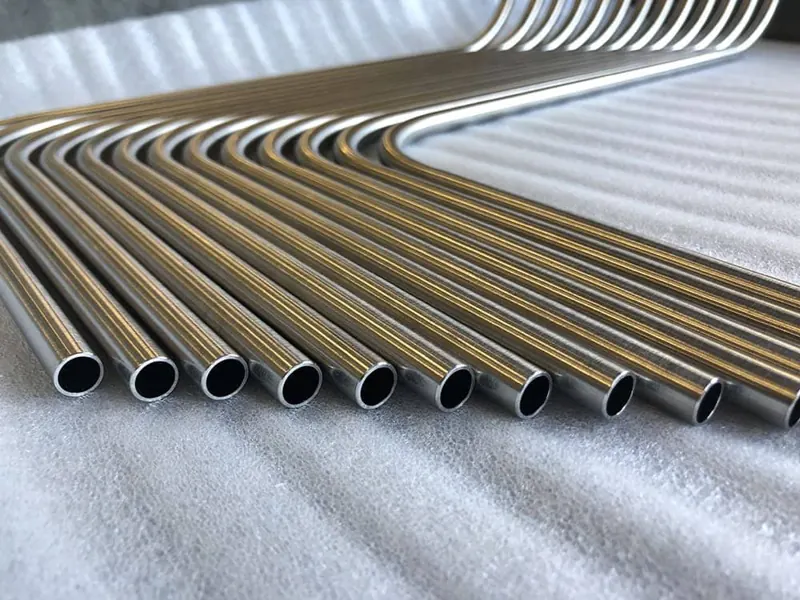
The short answer: Direct-to-chip liquid cooling put stainless steel piping, row manifolds and coolant distribution unit (CDU) hardware into data centers at scale, and with it a requirement that mechanical contractors did not used to carry: every stainless component must arrive passivated. Welding, grinding and field fabrication strip the chromium-oxide film and leave free iron that corrodes and fouls cold-plate microchannels. Industry guidance from ASHRAE TC 9.9 and the Open Compute Project now calls for internal surfaces to be pickled and passivated per ASTM A380 and A967 before installation. Harrison does that work shop-side in Houston — before the spool racks ship — so the field flush is a verification step, not a rescue.
Where finishing fits in a liquid-cooled build
Prefabricated stainless TCS piping and spools. Technology cooling system (TCS) headers, risers and branch spools fabricated off-site are pickled to remove weld heat tint and scale, passivated per ASTM A380/A967, verified, capped and bagged before they go on the truck. This is the highest-volume application and the one most often specified.
Row manifolds and distribution headers. Manifold assemblies with multiple drops and quick-disconnect ports are passivated internally and externally; electropolishing is added where the owner wants minimal particle shedding or an easier-to-flush interior.
CDU internals and heat-exchanger shells. Stainless wetted components inside coolant distribution units — manifolds, tanks, exchanger shells — are passivated or electropolished before assembly.
Backup-power gas systems. Where a site uses hydrogen fuel cells or gas turbines, the gas-train components are cleaned for service to the same CGA G-4.1 / ASTM G93 practice we use for industrial gas; see oxygen cleaning.
A note on cold plates: most are copper or aluminum, and stainless passivation does not apply to them. We will tell you when a component doesn't need our process.
The specifications
ASTM A380 (cleaning, descaling and passivation of stainless steel parts, equipment and systems) covers pickling of welded fabrications. ASTM A967 defines the passivation methods and the verification tests. The OCP pre-commission guidance for TCS row manifolds calls for 304-minimum stainless with internal surfaces pickled and passivated to ASTM A380 before arrival on site, inert-gas welding to avoid field pickling, and a flush to a turbidity target with fine filtration. ASHRAE TC 9.9 guidance warns that a single unpassivated component can jeopardize the loop. Harrison's certificate of conformance names the method and the verification test so it can be filed with the commissioning package.
Why shop-side, before the flush
Field flushing and chemical passivation of an installed loop is slow, consumes chemistry and water on a live site, and still cannot reach a weld that was never pickled. Passivating the spools and manifolds in a controlled shop, with full immersion and verification, means the on-site flush confirms cleanliness instead of creating it. For mechanical contractors prefabricating in Texas, our Houston facility is a drive, not a freight lane, and oversized headers can be handled with four overhead cranes and 15,000 lb capacity.
Representative project
A mechanical contractor prefabricating stainless TCS piping for a Texas hyperscale campus needed several hundred welded 304 spools and a set of row manifolds pickled and passivated before delivery, on a schedule tied to rack installation dates. Harrison processed the spools in rack batches — pickle, passivate per ASTM A967, verify, deionized-water rinse, dry, cap and bag — and returned each batch with a certificate of conformance keyed to the spool tags so the contractor's QA could file them against the commissioning plan. The loops flushed to specification on the first pass.
Request a quote for liquid-cooling piping
Tell us the alloy, the number and size of spools or manifolds, the specification (ASTM A380/A967, OCP or owner's spec), and your delivery dates. We'll quote within one business day; expedited service is available and lead times vary with shop load.
Request a Quote · Call 800-245-5707
- More to Know
Frequently Asked Questions
13002 Brittmoore Park Dr
Houston, TX 77041-7231
Phone: 800-245-5707
